
Kinematic viscosity/ momentum diffusivity:

 Kinematic viscosity/ momentum diffusivity:

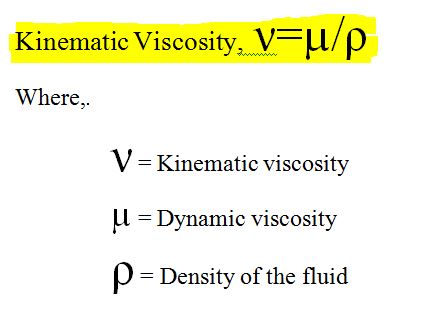
  • It is defined as the ratio of dynamic viscosity to the density of the fluid.
Kinematic viscosity

ν = μ / ρ                                                               

where

ν = kinematic viscosity (m2/s)

μ = absolute or dynamic viscosity (N s/m2)

ρ = density (kg/m3)

In the SI-system the theoretical unit of kinematic viscosity is m2/s - or the commonly used Stoke (St) where

  • 1 St (Stokes) = 10-4 m2/s = 1 cm2/s

Stoke comes from the CGS (Centimetre Gram Second) unit system.

Since the Stoke is a large unit it is often divided by 100 into the smaller unit centiStoke (cSt) - where

  • 1 St = 100 cSt
  • 1 cSt (centiStoke) = 10-6 m2/s = 1 mm2/s
  • 1 m2/s = 106 centiStokes

Comments

Popular posts from this blog

Application Areas of Fluid Mechanics

Application Areas of Fluid Mechanics It is important to develop a good understanding of the basic principles of fluid mechanics, since fluid mechanics is widely used both in everyday activities and in the design of modern engineering systems from vacuum cleaners to supersonic aircraft. For example, fluid mechanics plays a vital role in the human body. The heart is constantly pumping blood to all parts of the human body through the arteries and veins, and the lungs are the sites of airflow in alternating directions. All artificial hearts, breathing machines, and dialysis systems are designed using fluid dynamics (Fig. 1–7). An ordinary house is, in some respects, an exhibition hall filled with applications of fluid mechanics. The piping systems for water, natural gas, and sewage for an individual house and the entire city are designed primarily on the basis of fluid mechanics. The same is also true for the piping and ducting network of heating and air-conditioning systems. A refrigera...

Expression for capillary rise and capillary fall - Jurin's law

  Expression for capillary rise and capillary fall - Jurin's law Expression for height in Capillary rise Consider a narrow glass tube of diameter of d dipped in a liquid (say water). Water in the tube will rise above the adjacent liquid level. It is called capillary rise. Let σ = Surface tension of liquid. ϴ = Angle of contact between the glass tube and the liquid surface. h = Height of liquid column in glass tube. Under equilibrium, two forces are acting on the water inside. The first one is weight of water column and second is the upward force acting on water due to surface tension. The weight of liquid of height h should be balanced by the force at liquid surface. This force at surface of liquid is due to surface tension. The weight of liquid of height h in the tube = Volume x ρ x g = (π/4)d 2  x h x ρ x g Here ρ = density of liquid g = acceleration due to gravity. The vertical component of surface tensile force = surface tension x circumference x cosϴ = σ x πd x cosϴ At eq...

CLASSIFICATION OF FLUID FLOWS

 CLASSIFICATION OF FLUID FLOWS Earlier we defined fluid mechanics as the science that deals with the behavior of fluids at rest or in motion, and the interaction of fluids with solids or other fluids at the boundaries. There is a wide variety of fluid flow problems encountered in practice, and it is usually convenient to classify them on the basis of some common characteristics to make it feasible to study them in groups. There are many ways to classify fluid flow problems, and here we present some general categorie Viscous versus Inviscid Regions of Flow   When two fluid layers move relative to each other, a friction force develops between them and the slower layer tries to slow down the faster layer. This internal resistance to flow is quantified by the fluid property viscosity, which is a measure of internal stickiness of the fluid. Viscosity is caused by cohesive forces between the molecules in liquids and by molecular collisions in gases. There is no fluid with zero visc...